
#DigHum2025
Shaping our digital future!
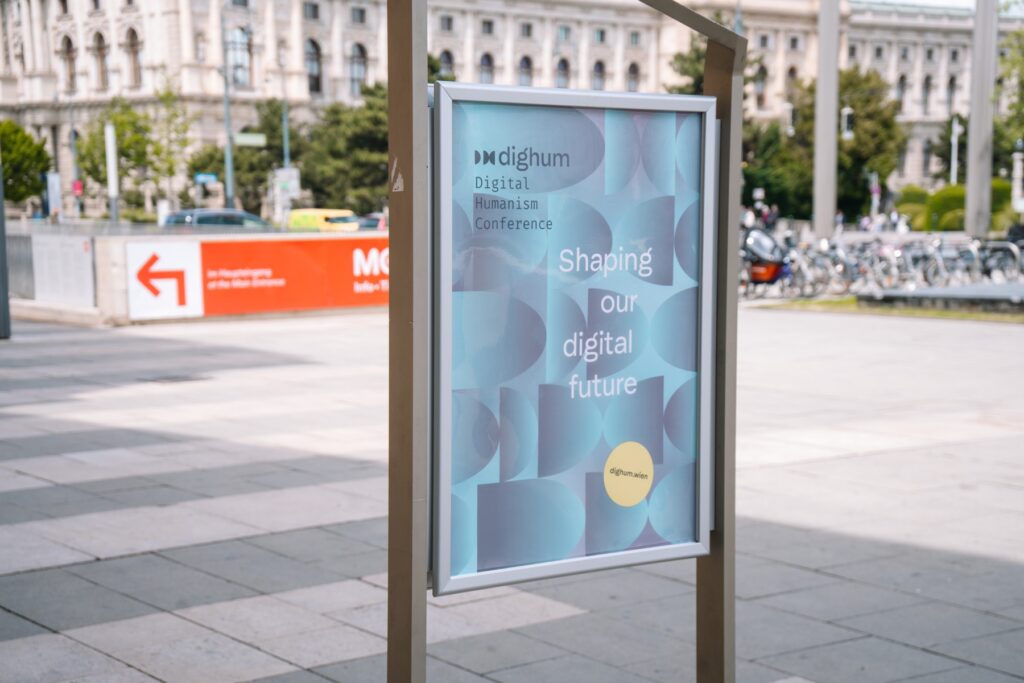
#DigHum2025 brought together experts to discuss technology through the lens of human values and democratic principles. Challenging the digital, empowering the human.
Thank you for being part of this conference!
The conference in 2025
The Digital Humanism Conference on 26 to 28 May brought together global thinkers, innovators, and policymakers to explore Digital Humanism’s potential.
Under the patronage of Austrian President Alexander Van der Bellen, renowned international speakers shared their perspectives, provided fresh insights, and highlighted potential pathways to creating a digital future that benefits all.
The three-and-a-half-day programme focused on AI and society, platforms and power and disruptive innovation, and opened with a splendid introductory evening at the cinema, featuring a screening of the AI-generated film Eno.
Monday, 26 May
AI and society
The first day of DigHum2025 Vienna focuses on societal challenges of AI. Starting from the politics of AI to questions of sustainability, robustness, and socio-economic issues the day will explore trustworthiness in AI and other societal challenges. It includes testing the limits of what we know as AI today.
Tuesday, 27 May
Platforms and power
Wednesday, 28 May
Disruptive innovation
The third day of DigHum2025 Vienna presents a dynamic programme of workshops, panels, and discussions, critically examining the nature of innovation—how disruptive is it really?
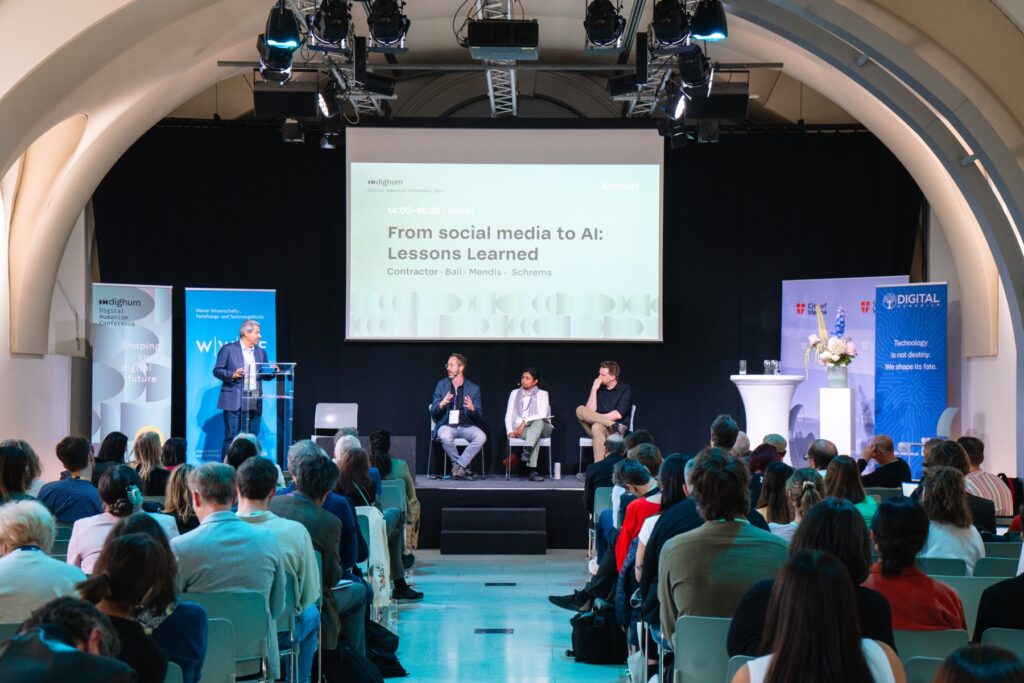
Speakers will explore the evolving role of AI in innovation, its potential for social transformation, and its impact on democracy. The day will feature reports on Austrian AI initiatives, discussions on teaching Digital Humanism, and debates on funding priorities for a sustainable and equitable digital future. Sessions will also draw lessons from social media, journalism, and civic participation in the age of AI.
Key statements and conclusions
Digital Humanism is essential to securing a good life in the digital age. Read about conclusions from the #DigHum2025.

Keynote speaker highlights
Highlights from our keynote and panel speakers:













Programme overview
Monday, 26 May
AI and society
The first day of DigHum2025 Vienna focuses on societal challenges of AI. Starting from the politics of AI to questions of sustainability, robustness, and socio-economic issues the day will explore trustworthiness in AI and other societal challenges. It includes testing the limits of what we know as AI today.
Tuesday, 27 May
Platforms and power
Wednesday, 28 May
Disruptive innovation
The third day of DigHum2025 Vienna presents a dynamic programme of workshops, panels, and discussions, critically examining the nature of innovation—how disruptive is it really?
Speakers will explore the evolving role of AI in innovation, its potential for social transformation, and its impact on democracy. The day will feature reports on Austrian AI initiatives, discussions on teaching Digital Humanism, and debates on funding priorities for a sustainable and equitable digital future. Sessions will also draw lessons from social media, journalism, and civic participation in the age of AI.
Partners of #DigHum2025
DighHum2025 thanks its great partner companies and organisations. Thank you!
Organised by

Supported by

In cooperation with





Statistics
- 3 1/2 days of programme
- 28 sessions as keynotes, panels, discussions, fish bowls, lunch and lightning talks
- Over 120 international speakers
- Around 500 guests in total from the global and national research and DigHum community, international experts, decision-makers from politics and administration and stakeholders from industry
- Many specials, like the DigitalCity couch corner and lunch talks, Kurier’s Was Jetzt Schule award ceremony with pupils, project lightning talks around DigHum in action and dedicated student sessions with speakers in conversation with students
- … and so many new connections and conversations between speakers and participants.
Media coverage
Browse a selection of press coverage on the 2025 conference – with some of our highlights marked with a star ★.
- Wien als Zentrum des Digitalen Humanismus – erste Internationale Konferenz mit hochkarätigen Panels und vielfältigem Programm (OTS, City of Vienna) 27 March 2025
- Wien als Zentrum des Digitalen Humanismus: Erste internationale Konferenz im Mai 2025 (Vienna Offices) 7 April 2025
- Erste internationale Konferenz für Digitalen Humanismus (MeinBezirk) 7 April 2025
- Erste Digital Humanism Conference in Wien vorgestellt (Austria Innovativ) 7 April 2025
- Die AI-Revolution, oder wie wir unsere Zukunft gestalten (Kurier print, Press reader) 24 April 2025
- ★ Experte: „Kinder wachsen bald mit Kl-Freunden auf (Interview with Moshe Vardi, Kurier print and Futurezone) 19 May 2025
- Digitale Humanisten treffen sich in Wien (Kurier print, Press reader) 19 May 2025
- ★ Gerechtigkeit & Grundrechte. Konferenz zum Digitalen Humanismus (ORF TV Kulturmontag) 26 May 2025
- Eröffnung der ersten internationalen Digital Humanism Konferenz in Wien (OTS, City of Vienna) 27 May 2025
- ★ Digitaler Humanismus von KI gefordert (ORF Science) 27 May 2025
- Internationale Konferenz für Digitalen Humanismus eröffnet (MeinBezirk) 27 May 2025
- Konferenz über die Spielregeln der KI (W24) 27 May 2025
- Digitaler Humanismus (in der Schule) (Linux in der Schule) 27 May 2025
- 26.05.2025 ORF.AT SCIENCE: Digitaler Humanismus von KI gefordert (University of Bamberg) 28 May 2025
- ★ Wie vereinbart man KI und Menschenrechte? (Der Standard, Netzpolitik) 29 May 2025
- DigHum-Konferenz: “Wir befinden uns in einem Dauer-Ausnahmezustand” (Futurezone) 2 June 2025
- Governance architectures for our digital future (United Nations University Centre for Policy Research (UNU-CPR)) 4 June 2025
- Digital Humanism Conference 2025 (Austrian Network for Information and Communication Technologies for Development (ICT4D) 6 June 2025
- ORF-Artikel über Ute Schmids Beitrag bei der Digital Humanism Conference (bidt Bayrisches Forschungsinstitut für Digitale Transformation) 6 June 2025
- SemSys at the Digital Humanism conference (Semantic Systems) 11 June 2025
- ★ DigHum Doctoral College Debuts at Digital Humanism Conference (Vienna Doctoral College for Digital Humanism, TU Wien) 16 June 2025
- “Counter Speech” bei Digital Humanism 2025 (University of Applied Sciences St. Pölten) 24 June 2025
- Ideenwettbewerb: Die Siegerinnen (Was Jetzt Schule) (no date)
Organisation
The conference board consisted of the Conference Chair, the Senior Advisory Board and the Programme Committee.
Conference Chair: Erich Prem (eutema GmbH, Digital Humanism Association)
Programme Chair: Hannes Werthner (TU Wien)
Senior Advisory Board: Noshir Contractor (Northwestern University), Misha Glenny (IWM), George Metakides (Digital Enlightenment Forum), Helga Nowotny (ETH Zurich), Moshe Vardi (Rice University)
Programme committee: Anita Eichinger (Vienna City Library), Peter Knees (TU Wien, UNESCO Chair on Digital Humanism), Katja Mayer (University of Vienna, ZSI Vienna), Michael Stampfer (Vienna Science and Technology Fund WWTF), Stefan Woltran (TU Wien)
The conference was organised by the Digital Humanism Association | Verein zur Förderung des digitalen Humanismus.
Thank you! Join us in 2026!